ESP32-C2
Ultra-cost-effective and low-power RISC-V microcontroller with Wi-Fi 4 and Bluetooth 5.3 LE
- Processor
- Single-core
- Up to 120 MHz
- SRAM
- 272 KB (16 KB for cache)
- + No RTC SRAM
- GPIO
- 14
- programmable pins
- Architecture
- RISC-V
- RISC-V single-core 32-bit
Official development kit
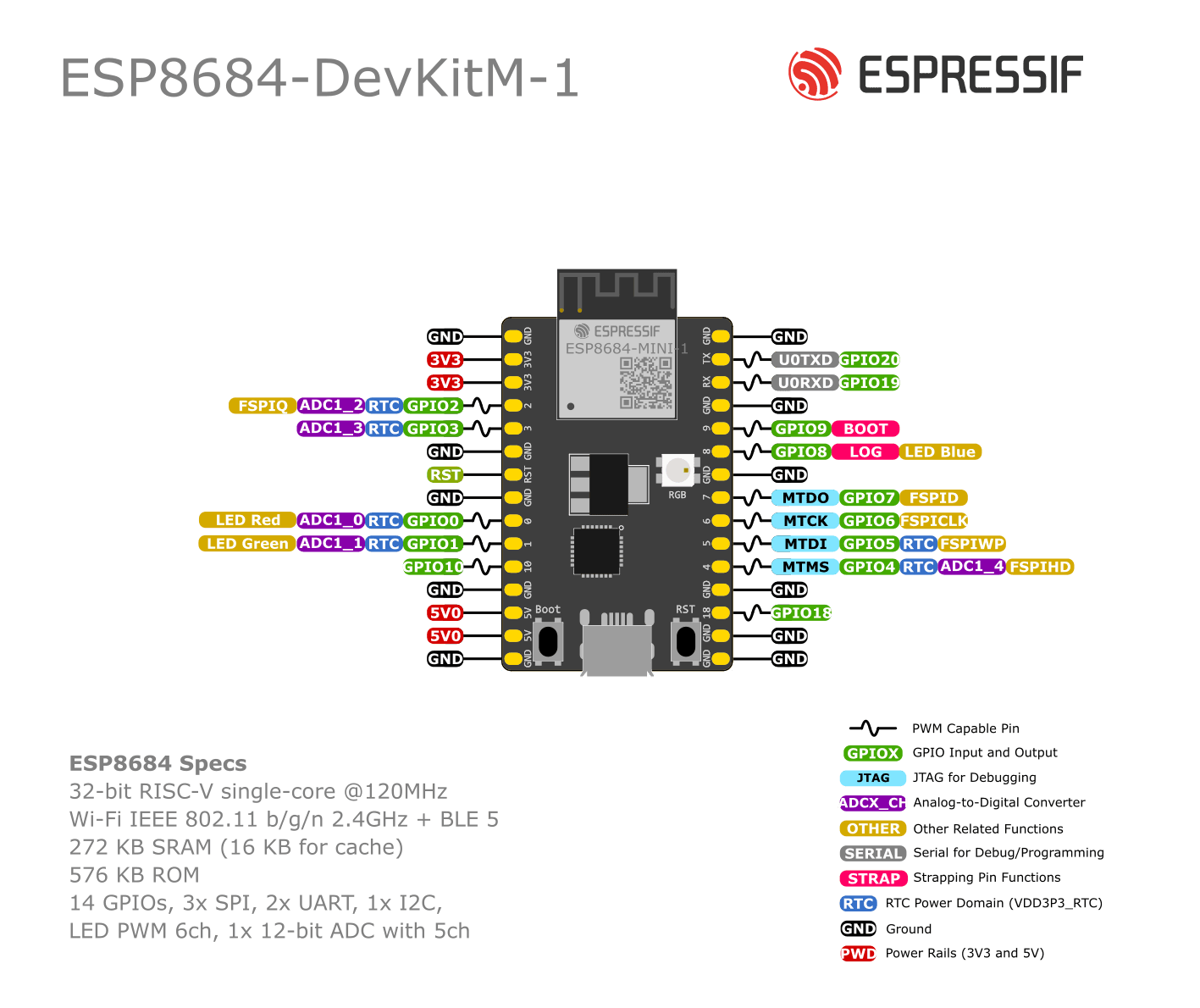
Official Espressif board for the ESP32-C2 series.
Pins with usage restrictions
Not every pin on the ESP32-C2 is free for general-purpose use. 7 of them have conditions: occupied by memory, sampled during boot, or function as input only. Check before finalizing your schematic.
Strapping pins (boot mode)
2 pins- GPIO8
- GPIO9
The chip samples the logic level of these pins during reset to determine the boot mode. You can use them after booting, but external circuitry must not force the wrong level during reset, or the board will fail to boot or enter download mode unexpectedly.
Flashing and debugging
4 pins- GPIO4
- GPIO5
- GPIO6
- GPIO7
These are the flashing UART and JTAG lines. They can still be used as GPIO, but reusing them removes the ability to flash and debug the board without disconnecting connected peripherals.
Must not float
1 pin- CHIP_EN
Require a defined hardware logic level: external pull-up or RC delay circuit. Leaving them floating causes random resets or unstable boot behavior.
These groups are derived from the same data as the pinout diagram. There you can see every pin's full functions, power domain, and complete engineering notes.
Open pinout diagramProcessor
- Architecture
- RISC-V single-core 32-bit
- Cores
- 1 (Single-core)
- Frequency
- Up to 120 MHz
- ULP Coprocessor
- No
- AI Accelerators
- No
Connectivity
- Wi-Fi
- IEEE 802.11 b/g/n (2.4 GHz, up to 72.2 Mbps)
- Bluetooth
- Bluetooth 5.3 LE (certified)
- Zigbee/Thread
- No
- Matter
- No
- Ethernet
- No
- CAN
- No
Tools and availability
- Minimum ESP-IDF
- v5.0
- Arduino Core
- Yes (1 board definition in official core)
- Debugging
- External JTAG (requires probe, e.g. ESP-PROG)
- Package
- QFN24 (4×4 mm)
- Available Modules
- ESP8684-MINI-1, ESP8684-WROOM-01C, ESP8684-WROOM-02C, ESP8684-WROOM-02UC and 5 more
Security
- AES
- No
- SHA
- SHA-1/224/256
- RSA / MPI
- No
- ECC (elliptic curves)
- Yes (P-192, P-256)
- Hardware ECDSA
- No
- HMAC
- No
- Digital Signature (DS)
- No
- Key Manager
- No
- Random Generator (TRNG)
- Yes (hardware TRNG)
- Flash Encryption
- XTS-AES-128
- Secure Boot
- V2 (ECDSA P-192 or P-256)
- DPA Protection
- No
Memory
- SRAM
- 272 KB (16 KB for cache)
- RTC SRAM
- No
- ROM
- 576 KB
- External Flash
- Up to 16 MB via QSPI, but unavailable in retail variants (ESP8684H2X/H4X have 2 MB or 4 MB in package and do not expose flash pins)
- External PSRAM
- No
Power consumption
Typical values at 3.3 V and 25 °C. Actual power consumption depends on radio duty cycle and configured clock frequency.
- Active Cpu 120mhz
- 10.7-15.6 mA (modem-sleep)
- Light Sleep
- 140 µA
- Deep Sleep
- 5 µA
Peripherals
- GPIO
- 14
- ADC
- 1x 12-bit SAR ADC, up to 5 channels
- DAC
- No
- Touch
- No
- UART
- 2
- SPI
- 3 (SPI0/1 for internal Flash, SPI2 for general use)
- I2C
- 1 (Master-only)
- I2S
- No
- PWM
- LED PWM (up to 6 channels)
- USB
- No
Special interfaces
- Temperature Sensor
- 1 (internal)
Temperature limits
- Operating
- -40°C to 105°C
- Storage
- -40°C to 150°C
Ready to prototype with ESP32-C2?
Explore development boards available for this series, with USB, onboard sensors, and official store links.